![]() |
DonateWith help from supporters like you, Debra of America continues to provide programs and services to people with Epidermolysis Bullosa and their families, and to support EB research.Thank You. |
![]() |
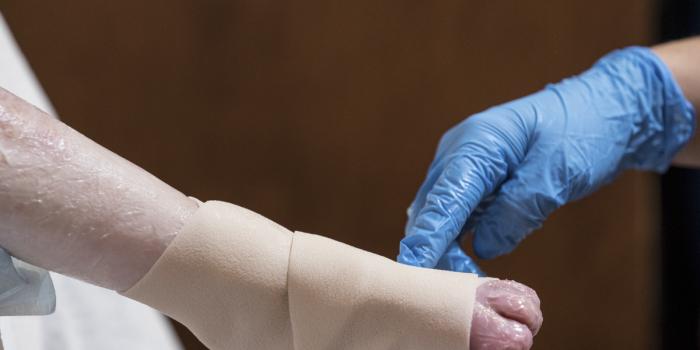
The mounting cost of bandages is most often not covered by an EB family's health insurance. | ![]() |
89.4¢ of every dollar donated goes directly to EB patients, families, and research. |
Ask the Debra Nurse
Ask The Debra Nurse is a popular column which runs in every issue of the Debra "Currents" newsletter to help answer some of the more difficult questions about caring for an EB patient. Columns by Geri Kelly-Mancuso, RN, Debra Nurse Educator follow:
| Topics | |
| Anemia | |
| Vaccinations | |
| Braces | |
| Breastfeeding and EB | |
| Tattoos and EB | |
| Wound Care and EB (Spanish and English) | |
| Kidney Issues and EB | |
| Preimplantation Genetic Diagnosis (PGD) and EB |
Dear Debra Nurse,
My son was diagnosed with anemia. I don’t know how this happened. We are on an oral iron supplement now and will be going back to recheck his levels in a couple of months. What happens if the supplement doesn’t work?
A: Anemia is not uncommon for those with EB, even when taking daily supplements. Blood loss from wounds, along with poor iron absorption can contribute to the problem. Taking the iron supplement with a citrus juice (if tolerated) can help absorption. If oral supplementation is unsuccessful, your physician may recommend an iron infusion (IV iron) to build up your son's iron stores. In some cases of more serious anemia, a transfusion of packed red blood cells (PRBC) is required.
Dear Debra Nurse,
I have a newborn with EB. Will he be able to receive the routine recommended vaccinations? Is there anything special we should tell our pediatrician about injections?
A: Vaccinations during early childhood provide an important defense against serious illnesses. There are no contraindications for routine vaccinations for children with EB. They should be given at the appropriate, scheduled times as directed by your pediatrician. Alcohol or another cleansing agent should be gently dabbed onto the area where the injection will be given. Following the injection, there should be no vigorous massaging to the area. Gentle pressure should be held on the injection site to be sure the medication doesn't leak out. Your baby may have a mild reaction to some vaccinations, including a slight fever (under 102 degrees F), fussiness, and redness in the thigh area where the shot was given. These symptoms typically last up to two days and should be discussed with your pediatrician.
Dear Debra Nurse,
My daughter's dentist is recommending braces. I am worried that she will have problems because of her EB.
A: It is worrisome for EB parents to consider braces for their children. There is potential for mouth sores and if braces are painful, they may interfere with food intake. That said, many individuals with EB have tolerated braces well. One suggestion from an EB dentist is to place a couple of brackets first, to see if the oral cavity can tolerate braces. Another suggestion is to use dental wax to cover the wires and smooth the surfaces of the braces to provide additional protection. You may want to ask your dentist if Invisalign is an option for your child. As with any child with braces, meticulous oral care will be required to get the best results..
Dear Debra Nurse,
My daughter has EB and is expecting her first child. We were discussing her plans with the new baby and she would like to breastfeed. Will my daughter be able to or will the friction of nursing cause her to develop blisters on her breasts? And are there ways to treat this to make it more bearable?
Your daughter should certainly try breastfeeding if it is her desire. It is possible that she might do as well with breastfeeding as a non-EB mom.
The experience of breastfeeding varies widely in the EB population. Very few EB moms have successfully breastfed their babies without any problems. Most have difficulty because when a baby suckles, blisters tend to form around the nipple area.
I would suggest that your daughter ask her OB/GYN doctor to recommend a lubricant that is baby-safe. She can apply this to her nipples prior to feeding the baby. If that alone does not help to reduce/prevent blistering, she can try a silicone nipple shield on her lubricated nipple. This may offer her some additional protection as the baby feeds.
If these methods are problematic, she can consider using a breast pump on her well-lubricated nipple. This will widen the diameter of pressure on her nipple. The pumped breast milk can then be bottle-fed to her baby. It is also possible that hand expression of her breast milk will be less traumatic to her breast tissue.
Not every technique works for every woman. It is important to remember that some EB moms are not successful when it comes to breast feeding and/or pumping their breast milk. Your daughter needs to know it is okay to bottle-feed the baby with formula if necessary. If she is not able to breastfeed, her pediatrician can recommend a good formula for her child.
There is often concern expressed that bonding occurs during breastfeeding and that the inability to breastfeed may prevent bonding between mother and child. The truth is that the acts of cradling the baby, making eye contact and talking or singing to the baby will allow a mom to bond with her child, even when bottle fed.
Best Regards,
Geraldine Kelly-Mancuso, RN
Debra EB Nurse Educator
Dear Debra Nurse:
I have EBS and have been considering getting a tattoo, the only real hesitation being the skin issue. Do you have any advice on this?
There are a few people with EB who have had tattoos. What has been learned from these individuals is that the milder your EB is, the easier it will be for you to tolerate the tattoo. Some patients with very mild EB who have skin that is not as fragile do fine with tattoos. The more fragile your skin, the more of a problem you may have. The problems others have had are pain, increased healing time and scarring.
You need to consider that with the skin fragility of EB, there is no guarantee of a good outcome, even in the hands of an experienced tattoo artist, and you could blister from the procedure and end up with a wound requiring care. Proper wound care will be very important- you will need to follow the post-tattoo care guidelines carefully. After your wound heals, it is possible that your tattoo may not look as you originally intended.
Another concern is that, in the event that you ever wish to remove your tattoo, your EB may limit your ability to have this done.
Good luck with your decision.
Best Regards,
Geraldine Kelly-Mancuso, RN
Debra EB Nurse Educator
Wound Care and EB - Spanish & English
Estimada Enfermera de Debra,
Mi hija tiene de 20 años de edad; ella padece de E.B. Distrófica y desde hace un par de meses tiene lesiones que le cuestan mucho sanar; y en estos días la atendió un ayudante y le indico que siempre debe utilizar un antibiótico en sus heridas y le recomendó uno llamado Bactroban.
No sabemos si utilizar una crema antibiótica a diario es conveniente para estas personas con EB. Puede usted brindarnos su comentario al respecto…
-Una mama preocupado
Estimada Mama,
Estoy escribiendo para contestar su pregunta acerca de su hija con sus heridas que esta usando mupirocina (Bactroban). Si las heridas estan infectadas, es propio usar un antibiotico fuerte, como mupirocina (Bactroban) con recita de su doctor. Pero este antibiotico no es para usar diario. Si usa cualquier antibiotico, tiene riesgo de conviértase una bacteria resistente Puede aplicar antibióticos tópicos que son suaves en las lesions. Polysporin o Bacitracin son efectivos en prevenir la infección y pueden ser alternados cáda mes o dos para disminuir la resistencia de la bacteria. Mupirocina (Bactroban) como todos los antibióticos por receta médica, deben ser usados solamente cuando hay recomendación de su doctor.
Por favor déjeme saber si le puedo ayudar en algo adicional.
Atentamente,
Geri Kelly-Mancuso, RN
Debra EB Nurse Educator
Dear Debra Nurse,
My daughter is 20y/o, has Dystrophic EB and for the last few months she’d had lesions that are difficult to heal. She was told by an assistant recently to use an antibiotic on her wounds and recommended Bactroban.
We don’t know if using this cream daily is recommended for people with EB. Can you tell us your thoughts?
-A concerned mother
I am writing to answer your question about your daughter’s wounds and the use of mupirocin (Bactroban). If her wounds are infected, it is appropriate to use a strong antibiotic like mupirocin (Bactroban) with a prescription from her doctor. However, this is not an antibiotic that should be used daily. If you use any antibiotic too often, you run the risk of developing resistant bacteria. You may use mild topical antibiotics like Bacitracin and Polysporin on her lesions. These are effective at preventing infections, and you can alternate them every month or two to reduce the risk of resistant bacterial infections. Mupirocin (Bactroban), like all prescription antibiotics, should only be used on a physician’s recommendation.
Please let me know if I may be of further assistance.
Sincerely,
Geri Kelly-Mancuso, RN
Dear Debra Nurse Educator,
I have heard a great deal in the EB community about kidney problems that affect those with EB. Can you tell me more? Is there a way to screen for them? -Needing Answers
Dear Needing Answers-
Diseases in the urinary tract system, which includes the kidneys, ureters, bladder and urethra are not common, but can be serious, even life-threatening, when they do occur. There is a need in the EB community for practical guidelines for monitoring and management of urinary tract system issues.
Glomerulonephritis (both acute and chronic), renal amyloidosis, IgA nephropathy and obstructive uropathy have been reported in both Junctional and Recessive Dystrophic EB. Each can lead to chronic renal failure (CRF). There are no hard numbers on how many in the EB community develop CRF.
Jemima Mellerio, BSc, MD, FRCP discussed protocols for the screening and management of urinary tract system issues at the IV International Symposium on Epidermolysis Bullosa in Santiago, Chile in September of 2007. The following reflects these recommendations:
Recommended Screening for Urinary System Disease:
- For RDEB and JEB patients:
- Twice a year:
- Urea and electrolytes
- Urinalysis
- Blood pressure check
- If these are not normal:
- Urine microscopy
- Urine culture
- Consider:
- Renal ultrasound
- DMSA scan
- Functional tests like a MAG 3 (diagnostic imaging)
- For JEB patients:
- Annually:
- Renal Ultrasound
- If this is not normal: DMSA scan
- If this shows scarring or discrepancy, consider functional tests like a MAG 3
- If obstruction is suspected, a renal ultrasound is recommended
- If vesico-ureteric reflux is suspected, consider a MAG 3 or a micturating cystourethrogram (MCU)
General Principles of Management:
- Avoid instrumentation and surgery if possible
- Urethral catheters are tolerated short term
- Supra-pubic catheters are well-tolerated longer term
- Avoid constipation and dehydration
- Encourage toilet training at a normal age
Sincerely,
Geraldine Kelly-Mancuso, RN
Debra EB Nurse Educator
Implantation Genetic Diagnosis (PGD) and EB
My firstborn child has a severe form of EB. Our genetic test results say it is a recessive form and both my husband and I carry the gene mutation. I have been told that there is a method, PGD, which can ensure I have an EB free baby when I have our next child. Can you tell me how it works? - New to EB
Dear New, Having the genetic mutation of your child’s EB identified is the first step in Preimplantation Genetic Diagnosis (PGD), improving your chances of having an EB free child. PGD is accomplished with in-vitro fertilization, in which the mother takes hormones to increase the number of eggs she produces during her monthly cycle. These matured eggs are surgically removed and then fertilized with the father’s sperm. When the fertilized egg reaches the eight cell stage, one of the cells is removed and analyzed at a special laboratory to see if it carries the EB mutations that were identified in the family. The fertilized eggs that do not carry the mutations can then be implanted. If pregnancy results from the implantation process, the child will be EB free, but may also be a carrier like the parents. This process has been used successfully in a number of EB families. However, it is very expensive and not always covered by standard health insurance. Successful pregnancy with live birth is achieved in approximately one third of PGD cycles. As with any medical procedure, you should discuss with your medical provider whether PGD is right for you.
Sincerely
Geraldine Kelly-Mancuso, RN
Debra EB Nurse Educator
For more information on Genetics and EB, you can go to www.genetests.com and at GeneReview, search for Epidermolysis Bullosa. Currently there are articles by Ellen G Pfendner, PhD and Anne W Lucky, MD on EBS, DEB, JEB and EB-PA available.
![]()
Return to Family Center
Related Information/Links
Help for New Parents
Nurse Educator
Support & Resouces