
Meet Carly and Kathryn: Joining Us at Par for a Purpose!
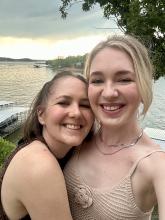
The countdown is on for Par for a Purpose: The debra Golf Classic, taking place Sunday, October 4, 2026, at the stunning Grayhawk Golf Club.
Hosted by debra of America, the day brings together supporters from across the country who are united in advancing care, advocacy, and research for those impacted by Epidermolysis Bullosa (EB).
This year, we’re especially excited to spotlight two members of the EB Community who will be joining up on the course: Carly and Kathryn. Sisters, athletes, and lifelong golfers, they bring a personal perspective on living with RDEB, growing up in a family shaped by resilience, and finding both challenge and joy in a sport that has remained a constant in their lives. Their story reflects not only the realities of EB, but also the strength and adaptability that define this community.
From all of us at debra, we are honored to have Carly and Kathryn join us this year at Grayhawk!
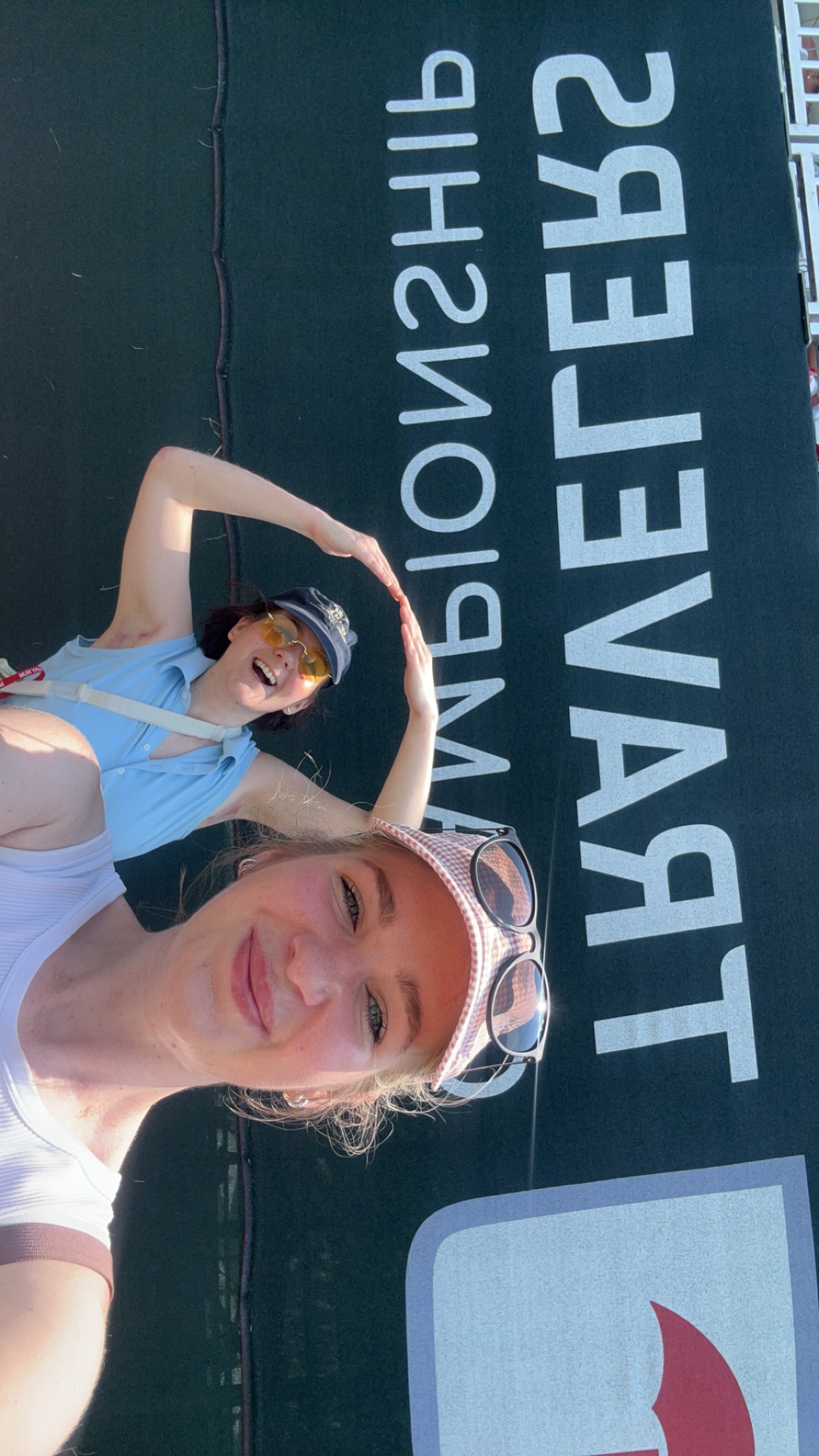
Can you please introduce yourselves?
Carly: Hi, my name is Carly! My sister and I grew up in Topeka, Kansas. I am 28 years old, and currently, I am finishing up my first year of Pharmacy School at the University of Kansas! Previously, I attended Kansas State University for my undergraduate degree (in biochemistry), and worked for a few years in manufacturing and clinical research. I had always considered becoming a healthcare professional, but I never felt like it was an ideal fit until I really learned what pharmacists do.
So, currently, I am back to being a full time student. I moved in with my aunt and uncle, and spend most of my time studying and attending class. Also, I occasionally help in a research lab. In my free time, I love to listen to music, attend concerts, do Zumba classes, and spend time with my cousins, friends, and dogs.
Kathryn: Hello! My name is Kathryn, I’m 26 years old and living in Boston. I moved to Massachusetts in 2022 after graduating from the University of Kansas with a degree in civil engineering. I work as a transit and rail designer at an engineering firm in our downtown Boston office. My curiosity for transit networks and passion for sustainable and equitable public spaces intersect nicely at my job, where my group supports planning and design of transportation infrastructure. I love that I contribute to creating healthier and happier communities through what I do, and I keep my EB identity in my back pocket when considering how people interface with and navigate their surroundings.
I like playing tennis, going to yoga and pilates classes, and of course golfing when I can catch a ride to the course — I have no car but did take my clubs on the train once. I spend time with friends and my big cousins also here in Boston enjoying our parks, beaches, hiking, theatres, and music scene in and around the city.
For those unfamiliar, how would you describe what living with RDEB means in everyday terms?
Carly: Our mom had a really nice answer she gave when she filled out forms for us growing up: our skin blisters or slides when exposed to friction or trauma. So, as we go about our lives, our skin breaks much easier than most people’s. It is unique from eczema or psoriasis in a lot of ways, but one of the main ones is that our skin doesn’t break out in response to exposure or our immune system, but rather, it is broken by an outside force. It does not take a lot to damage our skin, so we have to be thoughtful about how we move through the world and protect ourselves to avoid being injured, and require some special first aid supplies to wrap up and heal our larger than normal wounds.
RDEB varies so much between different people. The things that might cause a large blister on my skin might cause something smaller or larger on someone else’s. Many other people with RDEB I have met have many more bandages on much more consistently than my sister and I. With the varying RDEB presentations, the exact amount EB interferes with each person’s life varies a lot, but it absolutely impacts each of our lives daily. Kat and I’s basic approach is to steer away from activities that require a large amount of contact on our skin, and take care to use caution and protective measures when our skin is at risk. Growing up, this looked like sitting out of activities hard on our bodies or with high risk of falling: we did not participate in sports like soccer or tug of war. But we did dance, do gymnastics, play tennis, and my sister played basketball (all in addition to golf of course!). We wore gloves, knee pads, and elbow pads, and always were more cautious to not fall or bump into things than our peers.
As an adult with RDEB, I definitely still recognize the activities I have to opt out of or participate in moderation in, but both my sister and I have found passion for the activities that work well for our skin and enable us to stay active. We participate in many of our favorite activities now by making smart modifications. For example, my sister loves to do yoga, but she always does classes in grippy socks and uses a thicker mat with padded towels as needed. Also, sometimes we just participate and deal with the blisters and scrapes later. We both occasionally go skiing, and I have not figured out how to prevent my ski boots from creating some pretty large blisters on my feet and ankles. But, I am able to treat them and continue skiing without too much pain, and so I carry on!
The most significant source of skin issues for us are the bumps you take on as part of walking around and going about the day, things that do not cause scrapes and blisters for most people. For example, my sister and I are both terrible at opening things. Opening a jar requires A LOT of friction on your hand. We can tolerate some inevitable blistering, on our hands especially, to a point. But, we both occasionally utilize occupational therapy type tools to aid us in some of those activities of daily living type things. All in all, our skin issues are very easily managed through standard EB wound care. We simply move through the world more slowly and with intention.
Where we both feel most impacted by RDEB is actually in our mouths and throats. EB makes it difficult to eat food and brush your teeth! Our mouths and throats can be scraped and blistered just like our skin. Many people with EB have very narrow throats that continue to get smaller overtime, which makes it difficult to swallow food. Moreover, acid reflux can combine with EB to create esophagus ulcers without medicine and diet management. We both get surgeries every 1-2 years to have our throats opened a little wider. I think sitting down for a meal with us is when it becomes most apparent we have a chronic disease. We both eat very slow in order to adequately chew the food in order to make sure we can swallow it, and to minimize the amount it scrapes our mouths and throats. I know many RDEB patients struggle with food and nutrition more than we do. But overall, EB creates great challenges in getting enough calories and finding a diet that both provides nutrition and is soft enough to tolerate. A dietician is always a crucial part of an EB care team!
I also have to work very hard to carefully brush my teeth, because the toothbrush can create a lot of sores on my tongue and cheeks. Dentists and hygienists also have a hard time cleaning my teeth without causing mouth harm, and fitting their tools into my mouth to fill cavities, because my mouth opens very small due to scarring of my cheeks. I have even had to have a molar removed which became infected.
How did you first get introduced to golf, and what made it stick?
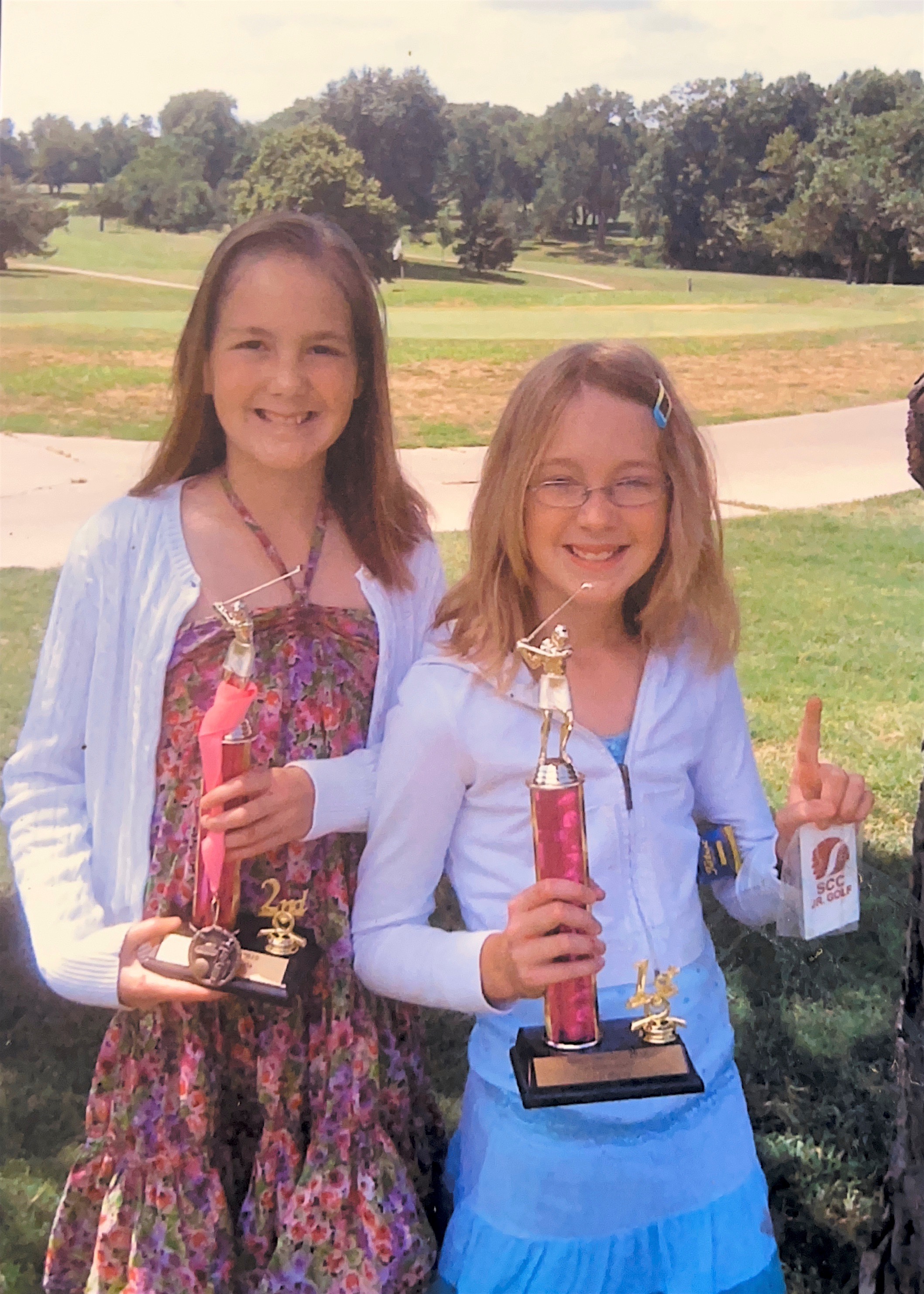
Kathryn: We were first introduced to golf by our dad, John, at ages 8 and 6 while growing up in Topeka. We have many family members who love the game of golf, including our grandpa, uncles, and cousins. From as young as I can remember, golf would be on the TV and I never understood how others found it boring because our dad made it so engaging. On trips to visit family in Memphis, we attended the St. Jude Classic tournament a few times as well. Our parents shared their love for the game with us early on and it really took no convincing for us to take to it.
When we first started junior golf, I remember the highlight was our kid version of the “19th hole” where we’d sit at the club restaurant and have Shirley Temples and frozen Reese's cups, typically followed by an afternoon at the pool – like most EB kids, we loved swimming. In earnest, the joy of bonding with other kids at junior golf and feeling like we were participating without inhibition was very meaningful to my sister and I at that age. Almost all other physical activities as young kids required us to show some level of restraint or vulnerability in the chance we’d take a fall. For example, a contact sport like basketball, which I also loved to play. We had wonderful golf instructors and eventually coaches that made us feel welcome in the sport, empowering us to feel like our skills were in our hands to improve with practice and dedication. It didn’t take long before we were going out on school nights for a 9-hole family scramble.
What is it about golf that works well for you, and what adaptations have you found helpful?
Kathryn: Golf is not a contact sport, it’s also a mental game as much as physical. The mental aspect is obviously true with most sports, but with golf there is almost a scientific quality that suits my sister and I’s personalities well. The strategy that goes into playing and feel that goes into fixing my golf swing is not limited by physical constraints of EB. The key adaptation for us is wearing golf gloves on both hands, sometimes doubling up one hand, which almost entirely eliminates blisters. When we do deal with blisters on our hands, we tolerate regular Band-Aids as needed. Sunshine and other elements of nature have no effect on our EB, and probably the best part about golfing for me nowadays is getting to eliminate distractions, separate from crowds, and enjoy time outdoors.
You both played competitively in high school, which is incredible. What was that experience like?
Carly: We both had so much fun playing high school golf. When we were younger, it never really occurred to me I would even want to play high school sports, never mind that we would both end up being part of state championship teams. It was extremely special for both of us to get to be a part of a team sport - we overlapped 1 year of high school, so we even got to be on the team together! I don't think there is another sport we could have done as well, due to the amount of contact that occurs or falls possible, except maybe running/track or cross country, or swimming and diving. But I was never good at those! I was surprised over my high school golf career how much I improved at golf. I practiced every day, and by my senior year, I was a really reliable contributor to the team. It was crazy to see myself shooting the same scores as the girls I admired so much growing up playing junior golf.
Most of all, golf is such an individual sport, it was really my first ever time being part of a team sport. I did not talk to the girls on my team much prior to high school, and I was surprised at how special of friendships I made over the four years. My teammates were amazing: they lifted me up and cheered me on as an individual, and I did the same for them, and we all contributed to something bigger than ourselves. When I think back to my favorite memories of high school, they are mostly from my time on the golf team.
What does it feel like to be out on a course together as sisters? What does that time mean to you?
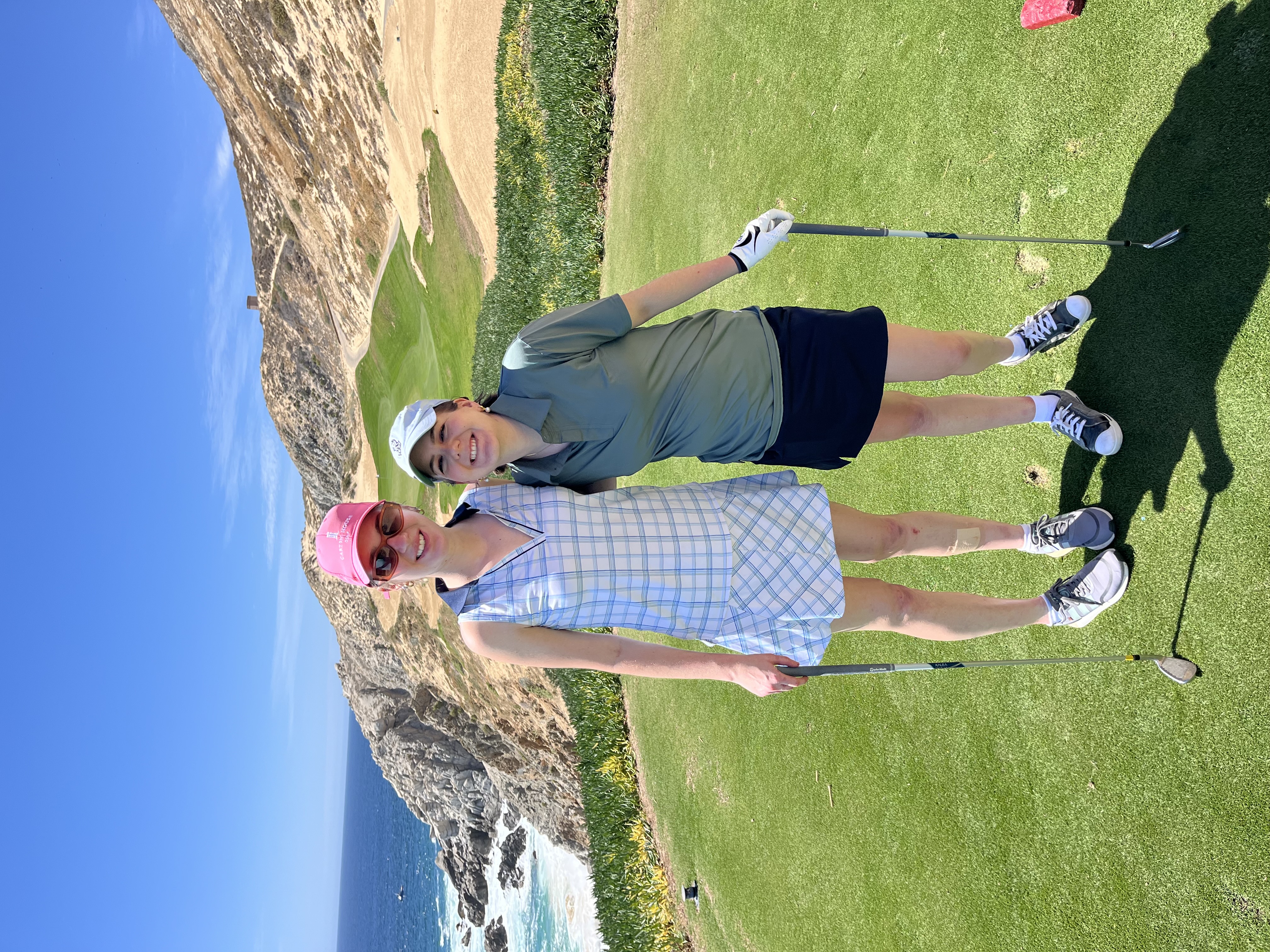
Carly: Golfing with my sister is one of my very favorite things to do in the world. My sister is my best friend, and I love spending time with her in any way. But it is so cool that both of us equally love golfing, so we have this combined amazing experience together of doing our favorite thing with our favorite person. Out on the course, you get that space and peace, and we can turn it into anything we want. Sometimes its playing music, laughing, and being silly. And sometimes, it is just quiet, calm, and the occasional deep conversation. I am also so glad we both love this lifelong game, so we can continue to have this special time together for many, many years!
Kathryn: When my sister and I play together we sometimes go into our own little world. We can also be a pretty good scramble team. Somehow the normal sibling arguing we do never happens on the golf course. Time spent on the course with each other is time when we are feeling our best and our hearts are full — we are grateful to be able to golf with one another! I love that I know she loves golfing too. Now that we aren’t able to play as often with one another, it makes it even more memorable when we do.
How has golf shaped your confidence or outlook on life beyond the course?
Kathryn: Golf often feels central to who my sister and I are. Almost all mantras that we’ve been hearing since we were girls, which were at times difficult to embrace, were shared on the course. The one my dad would say that I remember the most was “when the going gets tough, the tough get going.” He had several tied to his favorite golfer Jack Nicklaus, whose general philosophies included taking things one shot at a time and worrying about what you can control. Similarly, our high school golf coach would pointedly encourage each member of the team to “do your job.” In this spirit, as I go through life and my professional endeavors, I try to focus on what serves me and not worry as much about how others do things. I think golf has influenced my sister and I’s confidence knowing that we can be tough, compete, struggle, and make it out okay on the other side, sometimes surprising ourselves with our physical capabilities. Knowing we can fully throw ourselves into the game when we’re on the course and we’ll have golf as a lifelong sport and competitive outlet brings us both great joy.
What has debra of America meant to you and your family?
Carly: It is extremely significant to know there is a group of people out there who are thinking about how to improve the lives of anyone who has EB. And all but one person I have met with EB (not counting my sister) has been through debra! I am so grateful for debra for fostering connections between other EB patients and their families, and health professionals! I feel extremely supported in my healthcare and with EB, it would be very lonely without debra.
If someone has never heard of EB, what's the one thing you'd want them to walk away understanding?
Kathryn: Anyone with a chronic disease is impacted every day in ways that you wouldn't think about, and ways they probably don't even recognize because it is just life and they have learned to roll with it. Having EB brings a lot of daily physical and mental challenges, and dealing with them each day makes you very resilient.
What would you want the golfers teeing off at Par for a Purpose: The debra Golf Classic to know about why their participation matters?
Carly: When I was a kid there were NO treatments for EB to my knowledge! I believe there are currently MULTIPLE FDA approved EB treatments! This is incredible, and the most important factor in this progress is getting people to support research and care for the EB community. So, it is so meaningful that you choose to think about debra when looking for causes to support. I am so grateful that treatment options exist tailored for EB, but to put into perspective the challenges we with EB will continue to face, the new treatments speed up wound healing, and do nothing to prevent the occurrence of wounds. EB is very rare and complex, so ongoing support means so much to me personally, because you are supporting continued innovation in the management and cure of EB.
Kathryn: Thanks to amazing programs and services championed by debra, your participation can change the lives of families who are overwhelmed by EB and need support. My sister and I were lucky to travel to specialized medical care growing up and have health insurance coverage, but other kids are born into families with less options. As opposed to these families struggling and searching, it’s critical EB care and resources including subsidized wound care supplies, emergency care guidelines, and the EB doctor network continue to find them. Moreover, participants are supporting debra’s work promoting public awareness and education of the disease. This helps me as a member of the EB community feel more seen and understood, and there is a long way to go.
What do you hope for the future of EB care, support, and research - for yourselves and for the broader community?
Carly: I would love to see more dentists specialize in EB. It is very difficult for dental instruments to even fit into my mouth because it is very scarred and tender. I struggle a lot keeping my teeth and mouth healthy.
Otherwise, I feel extremely well supported as an EB patient, and hope we continue to spread awareness and push research forward to improve the lives of patients with all types and severities of EB. In my future, I hope to attend another debra Care Conference soon! They are such amazing resources for EB people, and I hope they continue forever as a place to learn about the most recent EB care updates and the place to connect with the community.
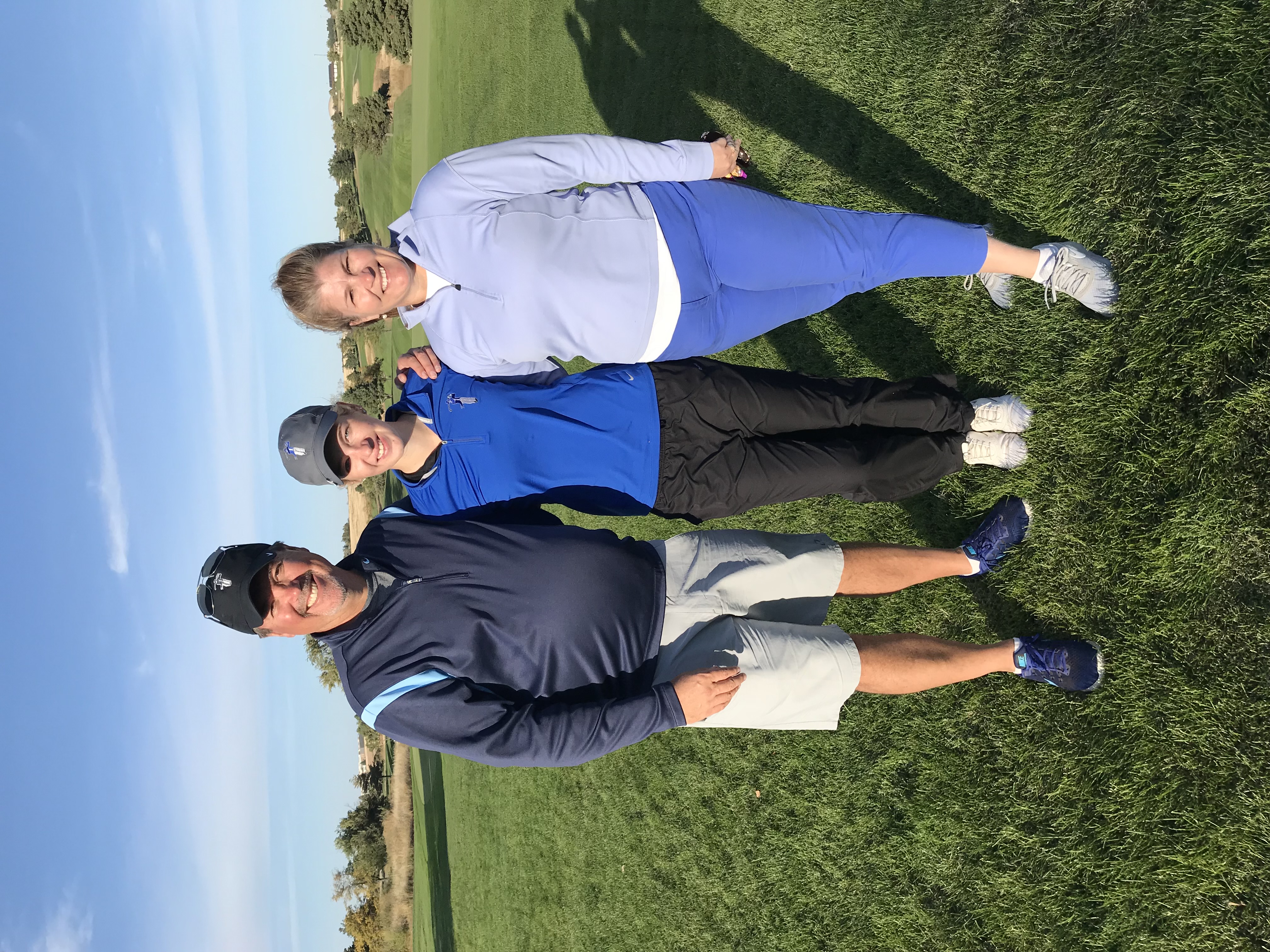
We're so excited to have you both at Grayhawk on October 4th! What are you most looking forward to?
Carly: I am so excited to take a break from school, spend time with my sister who I don’t get to see very often, meet awesome people who support EB, and have a fun day of golfing on a beautiful golf course! I also love the desert, it is so beautiful, so I am very excited to return for a visit to Arizona and my first ever chance to golf there.
Kathryn: I’m looking forward to connecting with other golfers over a cause that means so much to my family. Also I’ve never been to Arizona or really anywhere close by so I’m excited to experience a new place!
Have you done any scouting on the Raptor Course yet - any holes you've got your eye on?
Carly: I am looking forward to playing my first desert golf course. However, I am also nervous because this looks like it could be the hardest golf course I have ever played! I am just hoping to avoid hitting the ball into the desert.
Kathryn: Generally excited to see all the cacti. I am pretty nervous about a double bunker shot scenario looking at hole 14.
Join these incredible sisters alongside a passionate group of supporters for a fun day of golf featuring a shotgun start, on-course competitions, an exciting silent auction, and a lively 19th Hole cocktail reception—all coming together in support of the Epidermolysis Bullosa (EB) Community.
All proceeds from the event will benefit debra of America, a nonprofit organization dedicated to improving the lives of those impacted by EB — “The Worst Disease You’ve Never Heard Of.”